
PSCA releases annual survey of profit sharing and 401(k) plans
This year's survey contains 82 tables of data on topics such as participation rates, participant deferrals, company contributions, investment options, asset allocation, Internet usage, vesting, loans, and more. Data is frequently broken down by plan size and plan type.
Employee Participation and Deferral Rates
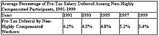
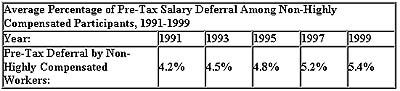
82.5% of eligible employees held balances in their 401(k) plans. Pre-tax deferrals averaged 5.4% of pay for lower-paid and 6.4% of pay for higher-paid employees.
Company contributions
The average company contribution was 4.7% of payroll. Company contributions were highest in profit sharing plans (8.6% of payroll) and lowest in 401(k) plans (3.3% of payroll). Company contributions averaged 25.9% of total net profit for profit sharing plans and 14.1% of total net profit for 401(k) plans.
Numerous formulas are utilized to determine company contributions. In plans permitting participant contributions, the most common formula is a fixed match only, present in 30.6% of plans. The most common type of fixed match is $.50 per $1.00 up to the first 6% of pay, present in 25.1% of plans that have fixed matches. The most common type of company contribution for profit sharing plans is a discretionary profit sharing contribution only, which is present in 51.1% of plans.
Matching contributions are most frequently made on a payroll period basis (48.6% of plans), while nonmatching contributions are most often made annually (76.4% of plans).
Investment Options
51.2% of companies offered 10 or more fund options for participant contributions in 1999, up from 38.8% of companies in 1998, and 30.6% of companies in 1997.
On average, 12 funds were available for company contributions and 11 funds were available for participant contributions in 1999.
The most commonly offered fund options for participant contributions were actively managed domestic equity funds (present in 85.7% of plans), actively managed international equity funds (present in 73.2% of plans) and balanced stock/bond funds (present in 72.7% of plans).
Asset investment
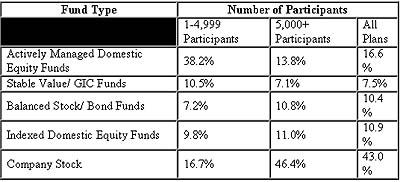
In plans with 1-4,999 participants, assets were most commonly invested in actively managed domestic equities (38.2% of assets), company stock (16.7% of assets) and stable value funds (10.5% of assets). In plans with 5,000 or more participants, assets were most commonly invested in company stock (46.4% of assets), actively managed domestic equity funds (13.8%) and indexed domestic equity funds (11.0%).
Service providers
Predominate services for defined contribution plans continued to be investment management, trusteeship and recordkeeping. Plan assets were most commonly managed by mutual funds (36.7% of assets), banks (18.3% of assets), insurance companies (16.8% of assets), investment advisors (11.0% of assets), and brokerage firms (9.6% of assets).
Bank trusteeship is the most common in plans with 5,000 or more participants, at 54.8%. Plans with fewer than 50 participants are most often self-trusted (74.9%). Overall, 46.8% of plans are self-trusted, and 28.1% use banks.
Recordkeeping services are provided most often by third party administrators (26.1%), banks (14.3%) and mutual funds (13.2%). 14.1% of plans use more than one recordkeeper.
Automated systems
The use of Internet in plan administration continues to increase rapidly; 64.0% of plans permit participants to make some type of transaction via the Internet, up from only 44.1% of plans in 1998. An intranet is used in 7.4% of plans.
Plan loans
Plan loans continue to be a common feature. 77.3% of the plans studied permit loans. Loans are permitted in 82.4% of 401(k) plans, 81.8% of combination plans, and 37.6% of profit sharing plans. On average, in plans that permit loans, 25.0% of participants have loans, averaging $5,936 per borrower. Loaned assets accounted for 1.4% of total plan assets in plans permitting loans.
Investment education
Companies continue to provide individuals with numerous tools for investment education. The most common are print materials (92.0%), Internet (44.6%) and slides/transparencies (39.7%).
More survey information
PSCA's 43rd Annual Survey of Profit Sharing and 401(k) Plans is available for $195.00 ($75.00 for PSCA members). Copies of past PSCA surveys are available for $20.00 each. For more details on the survey or membership information, call PSCA at (312) 441-8550 or e-mail PSCA.